API List
The Umo Editor Server enhances the capabilities of Umo Editor Next through HTTP or WebSocket interfaces. In the development environment, after starting the project, you can access the Open API documentation at http://127.0.0.1:1235/openapi.
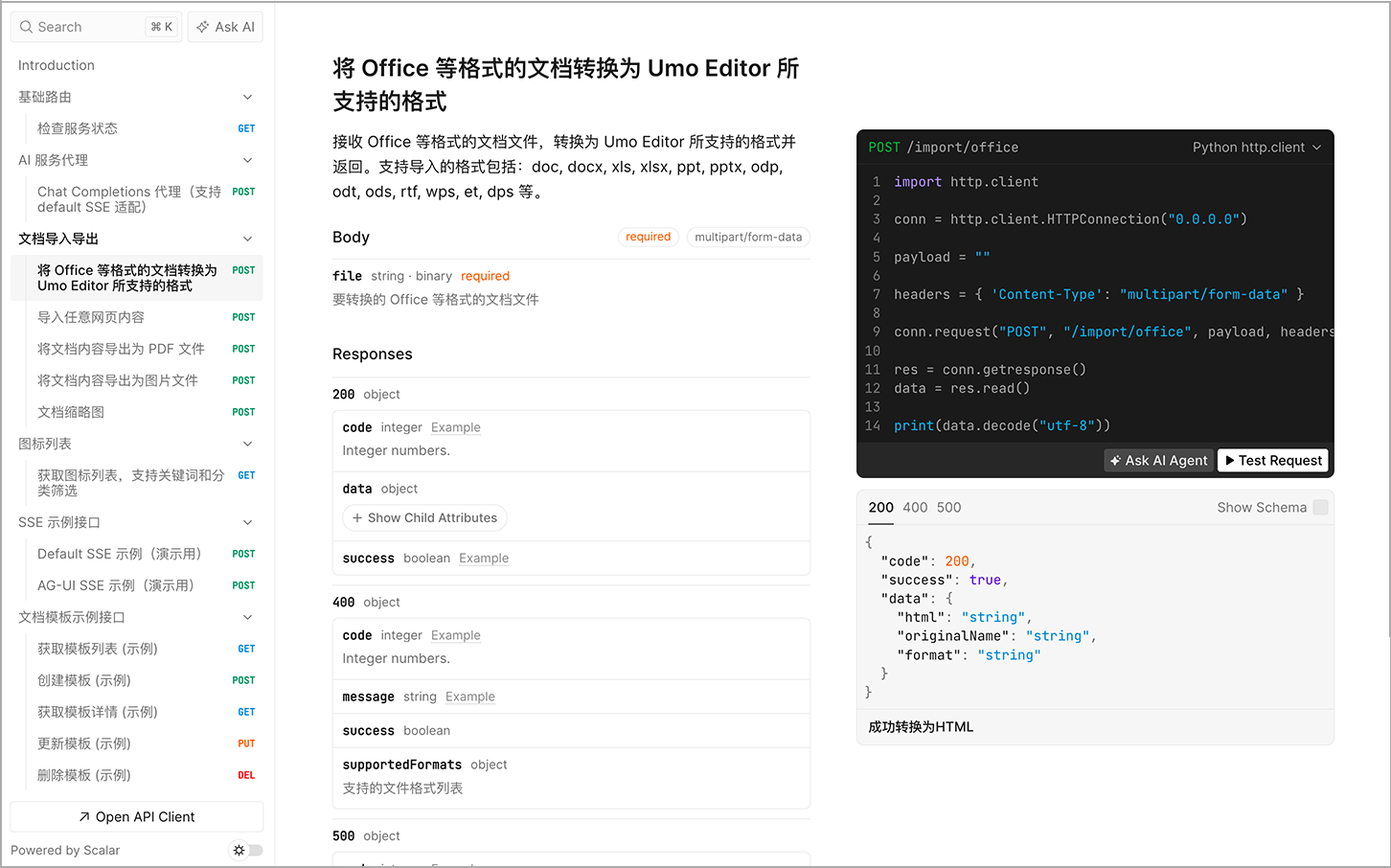
A brief description of the currently provided interfaces is as follows. For more detailed information, please refer to the interface documentation and code comments.
Check Service Status
GET /: Returns information about whether the service is running. If this route is inaccessible, it indicates that the service is not started or is experiencing issues.
Open API Documentation
GET /docs: API documentation for viewing and testing interfaces. This interface is not available in the production environment.
Document Import/Export
POST /import/office: Converts documents in formats like Office to formats supported by Umo Editor, including: doc, docx, xls, xlsx, ppt, pptx, odp, odt, ods, rtf, wps, et, dps, etc. The supported formats can be extended as needed.POST /import/anyweb: Imports content from any webpage into Umo Editor Next.POST /export/pdf: Export the document as a PDF.POST /export/image/:type: Export the document as an image, supportsjpeg,png,webpformats.POST /export/thumbnail: Export document thumbnail (exports only the first page content).
AI Service Provider Proxy
POST /ai/suggestion: AI smart suggestion endpoint for generating candidate continuations within the Umo Editor Next.POST /ai/{provider}/chat/completions: Dynamically proxies requests to different AI service providers (e.g., DeepSeek, OpenAI, etc.) based on theprovider. Can be extended and modified as needed. The main purpose of this interface is to forward requests to the specified AI service provider and return the response results that comply with the AI messages in Umo Editor Next. Please refer to the code comments for specific implementation and usage.
Collaboration, Comments, Version History, etc.
GET /collaboration: WebSocket interface, should be connected via the ws(s):// protocol. Most of the content of this interface is stored and transmitted in binary form. Please refer to the source code for its configuration and related instructions.
AI SSE Demo
POST /mock/sse/normal: SSE demo endpoint. Returnstext/event-stream. Thedatafield of each SSE is JSON, which is convenient for the frontend to parse with the default protocol. This endpoint is for demo/debug only and does not call upstream models.POST /mock/sse/agui: AG-UI SSE demo endpoint. Returnstext/event-stream. Thedatafield of each SSE is an AG-UI event JSON. This endpoint is for demo/debug only and does not call upstream models.
Template Endpoints
GET /template: Returns a list of all available templates.GET /template/:id: Returns detailed information for the template with the specified ID.POST /template: Creates a new template based on the request body and returns the created template details.PUT /template/:id: Updates the template with the specified ID using the request body and returns the updated template details.DELETE /template/:id: Deletes the template with the specified ID and returns the deletion result.
Asset Library Demo
GET /mock/file: List files and folders with pagination. SupportsparentId/keyword/type/pageIndex/pageSize.GET /mock/file/:id: Get file details by id.POST /mock/file/upload: Upload a file (demo).POST /mock/file/folder: Create a folder (demo).DELETE /mock/file/:id: Delete a file or folder by id (demo).
Icon List
GET /icons: Returns a list of all available icon information.
Static Files
Returns static files such as Umo Editor Next bundled files and @umoteam/editor-external, for example:
GET /static: Returns the main CSS file of Umo Editor Next, which can be used to configure thecdnUrloption of Umo Editor Next.GET /static/next/10.0.0/umo-editor-next.css: Returns the style file of Umo Editor Next, which can be used to configure theexport.styleURLoption of Umo Editor Next.